Many schools have worked with a uniform supplier at some point — sometimes for years, sometimes briefly — and the experience sometimes left them looking for something different. Some reasons behind. Spreadsheets emailed back and forth at the start of each school year. Mid-year reorders moved to May. Compliance documents missing when asked. Sizing chaos. Parents irritated. Administrators stretched.
The supplier wasn’t malicious. The model just doesn’t fit how schools actually work.
What schools are increasingly looking for — and what most of the European market still doesn’t offer — is a different kind of relationship. Not a uniform supplier. A school wear integrated service.
The distinction matters. Let’s walk through what it means.
What a uniform supplier does
A traditional uniform supplier sells garments. They have a catalogue. They take orders. They ship goods. The relationship is transactional — each order is a fresh interaction, the supplier’s job ends when delivery is confirmed, and the operational work between order and delivery sits with the school.
This works for some things. It does not work well for school uniform programmes, because school identity elements isn’t a one-off purchase. It’s an ongoing relationship between a school and its community that runs every year, with new pupils, sizing changes, replacement needs, year-group transitions, and occasional crest or colour evolutions.
When the supplier model is applied to this ongoing relationship, the school ends up doing most of the operational work themselves. Size collection. Order aggregation. Parent communication. Reorder coordination. Compliance documentation. Year-on-year continuity. All of this sits on someone’s desk at the school — usually the business manager or office administrator — alongside everything else they’re responsible for.
What a school uniform integrated service does
A school uniform service takes responsibility for the whole operational arc, not just the garment delivery.
That means the service handles:
The crest and design work — adapting the school’s visual identity symbols into materials that work well for embroidery, ensuring it scales cleanly across patches, polos, hoodies, and other garments. Many schools don’t have a crest file optimised for production — a good service makes that part of the offering, not a separate cost.
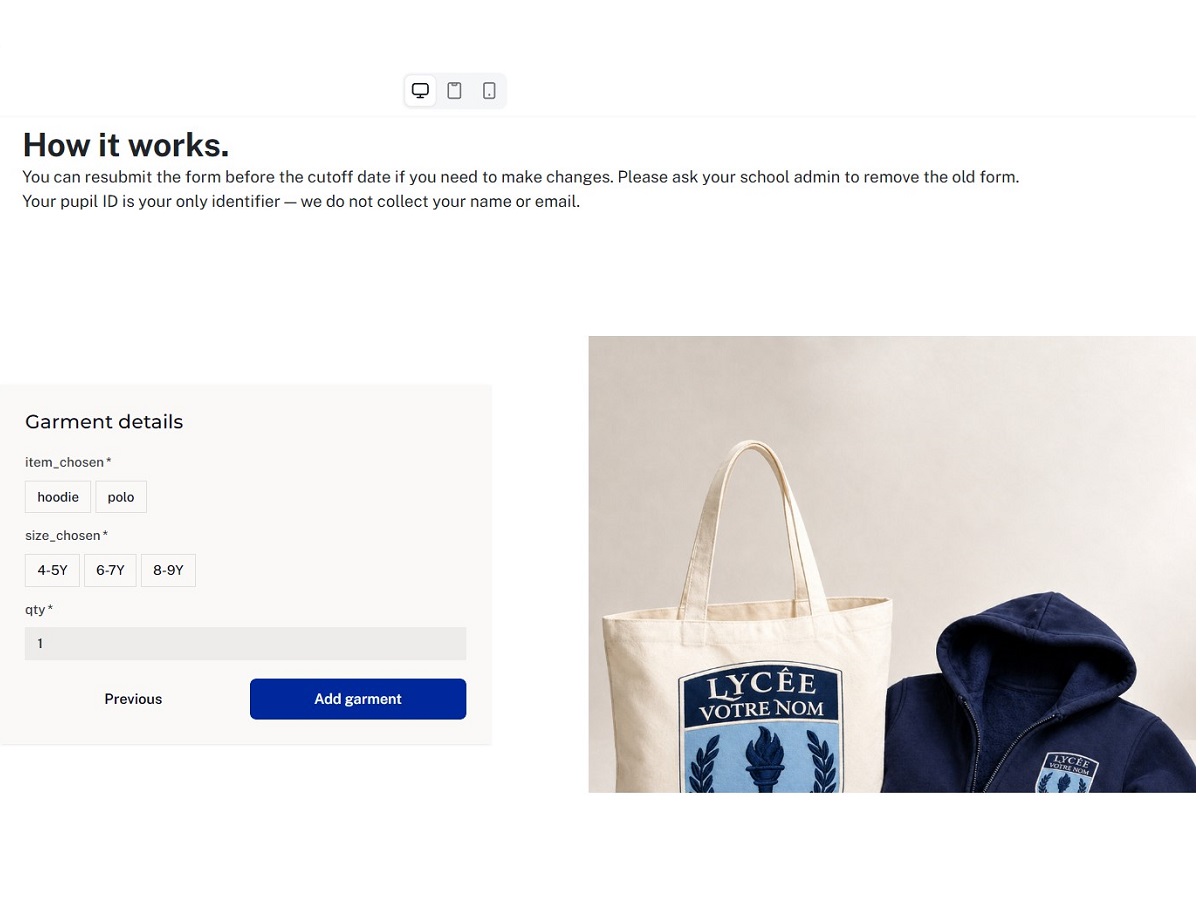
The parent-facing ordering — through a modern portal designed around how schools actually work. Anonymised pupil IDs (no parent emails harvested, no GDPR liability sitting on the school’s data desk), sizing guides parents can use confidently, dashboards administrators can read in seconds. Not a supplier shop bolted onto the school’s process. A tool built for schools.
The compliance and documentation pack — OEKO-TEX certificates, REACH declarations — provided proactively, without the school needing to chase. The school has the paperwork before they ask.
The production and quality control — with EU producers and suppliers vetted personally, samples shipped before commitment, quality checked at every batch. The school doesn’t worry about whether the next delivery matches the previous one.
The ongoing relationship — multi-year partnership rather than transactional supply. The same service team year after year. The same crest specification. Mid-year reorders, available when needed, not when the supplier feels like running another production cycle. Annual review of whether the programme is working, and adjustments where it isn’t.
Why this matters operationally
For school administrators, the difference between these two models is significant. The supplier model adds work to the school’s plate. The service model removes work from the school’s plate.
That isn’t a marketing distinction. It’s an operational reality with measurable impact. A typical school running a uniform programme through a traditional supplier spends administrative hours on programme management — collecting sizes, processing parent requests, coordinating with the supplier, chasing missing orders, handling mid-year requests, gathering compliance documents when needed. That’s a school administrator’s time, on a task that isn’t probably core to running a school.
A school running a uniform programme through a managed service can reduce that operational load. The remaining hours are signing off on specifications, approving samples, and reviewing year-end reports — meaningful decisions, not administrative chasing.
For schools with stretched office teams (which is most schools), this difference matters.
What schools should look for
Choosing between a uniform supplier and a school wear integrated service isn’t always obvious from a website. Many traditional suppliers describe themselves with modern language. The distinction shows in the substance, not the marketing.
Six things tell you which model you’re actually buying:
A modern parent ordering portal. Not a downloadable order form. Not a spreadsheet emailed at the start of term. A real portal with data privacy approach, real-time admin dashboards, and self-service for parents. If the supplier can’t show you the portal in a 15-minute demo, they don’t have one.
Compliance documentation provided proactively. Ask for OEKO-TEX certificates, REACH declarations. A serious service sends these quite fast. A different type of supplier hesitates or sends a generic brochure instead.
EU production with named partners. Vague answers about “European production” usually may mean overseas production with EU finishing. A serious service can name every partner, where each item is made, and provide origin documentation per shipment.
Multi-year partnership orientation. Ask: “What does year three of our partnership look like?” Some suppliers struggle with this and think in terms of individual orders. A service can describe the ongoing relationship: how reorders work, how new specifications get added, how the partnership evolves as the school grows or changes direction.
Honesty about timelines and capacity. A good service tells you when something isn’t realistic. If a supplier promises a full uniform programme delivered in four weeks for a September start in mid-August, walk away. The service that says “that timeline is too tight, let’s discuss what’s realistic” is the one to trust.
Tiered programme options. A school uniform and schoolwear service understands that different schools have different needs and budgets. They offer multiple tiers — from accessible entry points to premium custom production — so the school’s community gets a fit, not a one-size-fits-all premium offering.
The business model behind the service
There’s a final point worth making, because it explains why many of the market still operates on the supplier model.
Running a uniform programme as a service is operationally heavier than running it as a supplier. It requires investment in portal technology, sustained relationships with EU producers, proactive compliance management, and a team that can hold multi-year conversations with schools. The unit economics are tighter than running a transactional catalogue business.
Many traditional uniform companies don’t make the investment because the supplier model has worked for them for decades. The schools — sometimes frustrated, but mostly resigned — keep adapting to the supplier’s processes because that’s what they’ve always done.
That’s the gap a school uniform integrated service exists to fill.
For schools considering a change — or starting a programme from scratch — the question to ask isn’t “who has the best catalogue?” It’s “who will be a real operational partner over the next five years?”
The answer determines whether running your school uniform programme adds to your administrator’s workload, or removes from it.
If you’re reviewing your school’s uniform programme — whether you’re moving from blazer-and-tie to a modern polo-and-hoodie approach, starting fresh, or looking to replace a supplier that isn’t working — we’d like to hear from you. A 30-minute conversation, no pitch.